
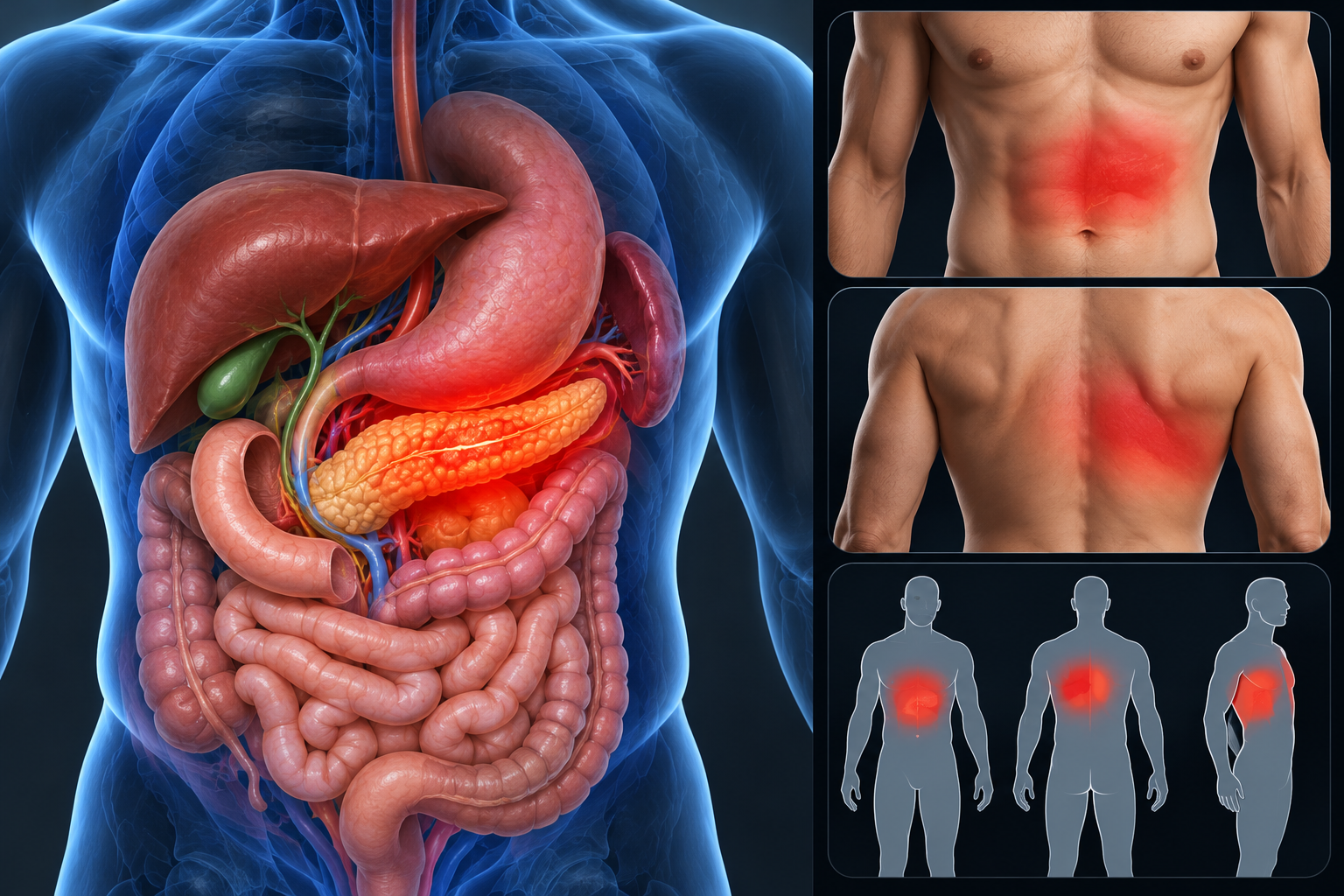
Pancreas pain is usually felt in the upper middle part of the abdomen, just below the breastbone and above the navel. In about half of cases it also spreads straight through to the middle of the back. It tends to be a deep, steady ache that gets worse after eating or when lying flat, and eases when you sit up and lean forward.
This article explains exactly where the pain is felt, what it feels like, how it differs from other causes of pain in the same area, and when it needs medical attention.
Where The Pancreas Sits
The pancreas is a soft gland about 12 to 15 cm (roughly 6 inches) long. It lies crosswise in the upper abdomen, behind the stomach and in front of the spine, at about the level where the lowest ribs meet in the middle.
It has three parts:
- Head: slightly to the right of the midline, tucked into the curve of the first part of the small intestine (the duodenum).
- Body: the middle section, crossing the midline behind the stomach.
- Tail: the narrow end, reaching to the left toward the spleen, under the left ribs.
Because the pancreas sits so far back, its pain feels deep inside the body, not near the surface. Pressing on the belly often does not pinpoint it.
Where is Pancreas Pain Felt
Main site. The pain is felt in the upper middle abdomen. This is the soft area just below the breastbone and above the navel, which doctors call the epigastric region.
By part of the pancreas. The exact spot can shift depending on which part is affected:
| Part affected | Where the pain is usually felt |
|---|---|
| Head | Upper middle abdomen, or slightly to the right |
| Body | The middle of the upper abdomen, often going through to the back |
| Tail | Left upper abdomen, under the left ribs, occasionally up toward the left shoulder |
Spread to the back. The pancreas rests against the nerves that run in front of the spine. For that reason the pain is often felt in the middle of the back as well, between the bottom of the shoulder blades and the waist. People commonly describe it as a band or belt around the upper body, or as pain boring straight through from front to back.
Pain felt only in the back, with no abdominal pain at all, is far more likely to come from the muscles or the spine than from the pancreas.
What Pancreas Pain Feels Like
Pancreas pain has a fairly consistent pattern:
- Deep and steady. It is a constant dull, gnawing or severe ache. It is not sharp surface pain and not cramps that come in waves.
- Long-lasting. It continues for hours to days, not minutes.
- Worse lying flat. Lying on the back presses the pancreas against the spine.
- Better leaning forward. Sitting up and bending forward, or curling up with the knees to the chest, usually eases it.
- Worse after eating. It often increases 15 to 30 minutes after a meal, especially a fatty one, and after alcohol.
- Not relieved by the usual things. Passing gas, a bowel movement or an antacid makes little or no difference.
Nausea and vomiting often come with the pain. Vomiting usually does not relieve it.
How The Pain Differs by Condition
Three pancreatic conditions cause most pancreas pain. The location is similar in all three, but the timing and the other symptoms are different.
| Condition | Typical pain | Other signs |
|---|---|---|
| Acute pancreatitis | Sudden, severe, constant upper abdominal pain that builds quickly and often goes through to the back | Nausea, repeated vomiting, fever, a swollen and tender belly, fast pulse |
| Chronic pancreatitis | Recurring or constant dull pain in the upper abdomen and back, often flaring after meals | Weight loss, pale greasy stools that float and smell strong, diabetes in later stages |
| Pancreatic cancer | Often no pain early on. Later, a vague dull ache in the upper abdomen or mid-back that slowly worsens and may be worse at night | Yellow skin or eyes, dark urine, pale stools, itching, unexplained weight loss, newly diagnosed diabetes |
Gallstones and heavy alcohol use are the two most common causes of acute pancreatitis. Long-term heavy drinking is the most common cause of chronic pancreatitis.
Most upper abdominal pain is not caused by cancer. Pancreatic cancer is included here because it is one of the possible causes, not because it is a likely one.
Other Conditions That Cause Pain in The Same Area
Several organs sit close to the pancreas, and pain from them is often mistaken for pancreas pain. In practice these conditions are more common than pancreatic disease.
| Source | Where it is felt | How it differs from pancreas pain |
|---|---|---|
| Gallbladder (gallstones) | Right upper abdomen, sometimes to the right shoulder blade | Comes in attacks after fatty meals and usually settles within a few hours |
| Stomach ulcer or gastritis | Upper middle abdomen | Burning quality, linked to hunger or meals, often eased by antacids |
| Acid reflux | Behind the breastbone | Burning that rises toward the throat, worse on bending or lying down after eating |
| Heart | Chest or upper abdomen, sometimes to the arm, neck or jaw | Often brought on by exertion, with breathlessness or sweating |
| Kidney (stones or infection) | Side of the back below the ribs, sometimes down to the groin | Comes in waves, often with burning or blood on passing urine |
| Muscle or spine | Back or abdominal wall | Changes with movement, posture or pressing on the sore spot |
| Gas or indigestion | Anywhere in the abdomen, often shifting | Crampy, moves around, eases after passing gas or a bowel movement |
How Doctors Confirm The Pancreas is The Cause
The location of the pain can only raise suspicion. It cannot confirm that the pancreas is the source. Doctors use tests for that:
- Blood tests. Lipase and amylase are enzymes made by the pancreas. A level three or more times above the upper limit of normal points strongly to acute pancreatitis.
- Ultrasound. Usually the first scan, mainly to look for gallstones.
- CT or MRI scan. Gives a detailed picture of the pancreas itself and shows swelling, fluid, scarring or a growth.
- Stool test. A fecal elastase test checks how well the pancreas is producing digestive enzymes. It is used when chronic pancreatitis is suspected.
Acute pancreatitis is diagnosed when at least two of these three are present: typical pain, raised lipase or amylase, and typical findings on a scan.
When to See A Doctor
Go to an emergency department if you have severe upper abdominal pain that does not ease within a few hours, especially with any of these:
- Repeated vomiting, or being unable to keep fluids down
- Fever or chills
- Yellow skin or yellow whites of the eyes
- A hard, swollen or very tender belly
- A racing heartbeat, fast breathing, dizziness or fainting
- Chest pain, or pain spreading to the arm or jaw
Acute pancreatitis can worsen quickly and is treated in hospital, usually with fluids through a drip, pain relief and monitoring.
Book a regular appointment if you have:
- Upper abdominal or back pain that keeps returning, especially after meals
- Weight loss you cannot explain
- Pale, greasy stools that are hard to flush
- Diabetes that was diagnosed recently along with any of the above
Also Read CapCut Pro APK Download 2026: Latest Android Version & Features
Frequently Asked Questions
It is mostly in the middle of the upper abdomen. It can lean to the left when the tail of the pancreas is involved, or slightly to the right when the head is involved.
Rarely. Back pain from the pancreas almost always comes with pain in the upper abdomen. Back pain on its own is usually from muscles, joints or the spine.
In acute pancreatitis the pain is constant and lasts for days. In chronic pancreatitis it can come in flares lasting hours to days, with pain-free gaps, or it can be present all the time.
Gas pain is crampy, moves around the belly and eases after passing gas or a bowel movement. Pancreas pain stays in one place, is steady, and does not ease with either.
Mild acute pancreatitis usually settles within about a week with hospital treatment. Severe cases take longer. Chronic pancreatitis causes pain that can continue for months or years and needs long-term management.
Yes. Some people with chronic pancreatitis have little or no pain, and early pancreatic cancer often causes none. In those cases the first signs may be weight loss, greasy stools, jaundice or new diabetes.
Summary
Pancreas pain is felt in the upper middle abdomen and often goes through to the middle of the back. It is deep and steady, worse after meals and when lying flat, and better when leaning forward. Many other conditions cause pain in the same place, so blood tests and a scan are needed to confirm the cause.